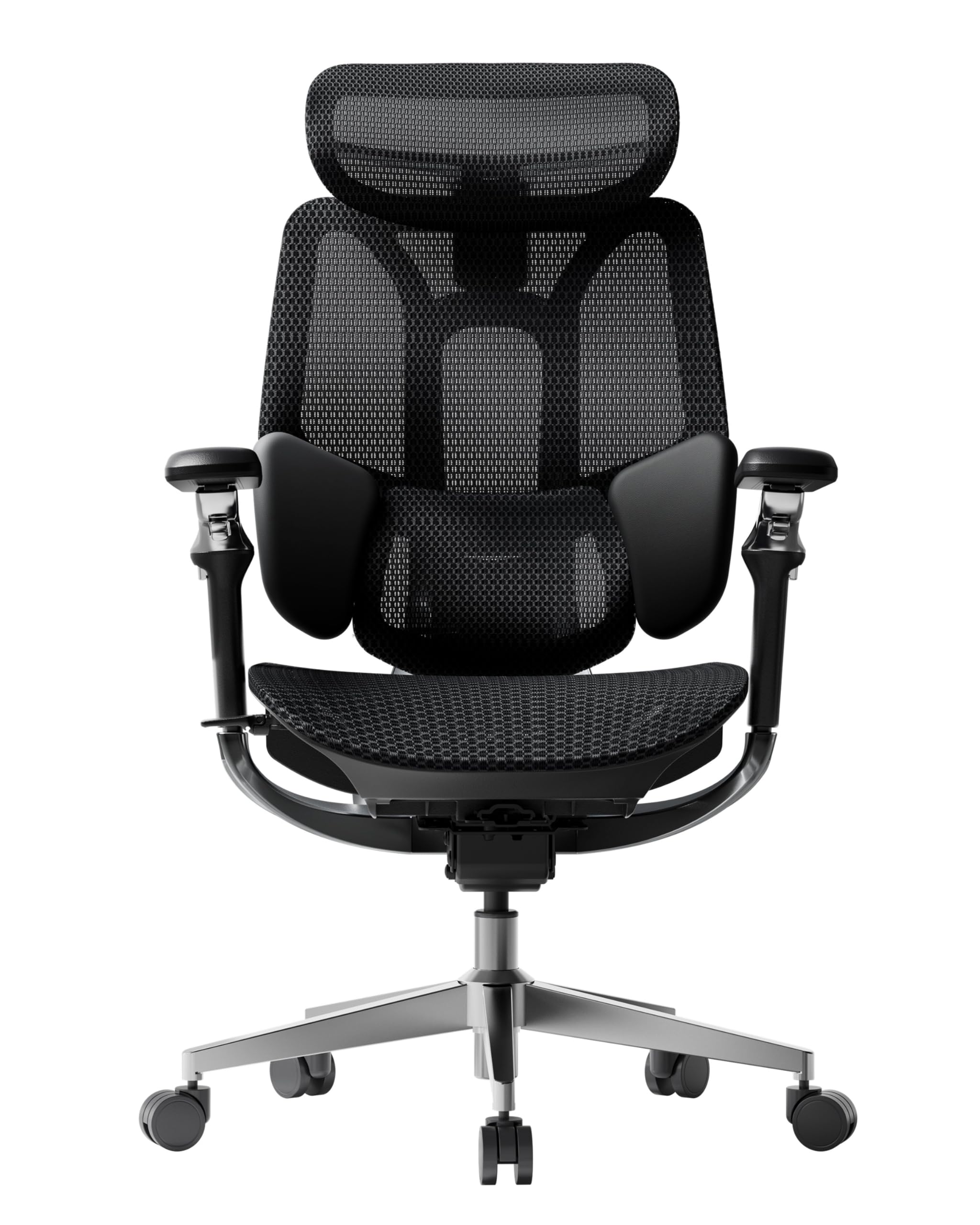
This review hbada e3 pro guide looks at a mesh office chair built around adjustable support and multiple ways to change posture through the day.
Its most distinctive features are a three-zone lumbar assembly, a deeply adjustable headrest, and armrests designed to rotate and fold.
Hbada E3 Pro Review Summary
The quick verdict
1,000+ ratings
Read Amazon ReviewsHbada E3 Pro
A mesh office chair for desk workers who want adjustable lumbar, headrest, arm support, and recline for different seated postures.
- Three-zone lumbar support uses pivoting side wings with a stated 40°–80° movement range and 60 mm of vertical adjustment.
- The headrest adjusts by 70 mm in depth and 40 mm in height, with 70° of rotation.
- The chair reclines up to 140°, with suggested positions at 105°, 115°, 130°, and 140°; tilt tension is described as responding to body weight.
- The mesh seat and back are described as high-elasticity CloudMesh, with airflow as a design goal.

Pros
- The lumbar support can be adjusted vertically and shaped around the sides of the back.
- The headrest offers height, depth, and angle adjustment for users who want to position neck support precisely.
Consider before buying
- Its many adjustment points may take time to set up; buyers who prefer a simple, fixed-feel chair may not use the full range.
- The stated 300-pound maximum and 5 ft 1 in to 6 ft 5 in height range are important fit boundaries to check against your needs.
Read the full review summary
The E3 Pro puts a broad range of fit adjustments in one chair.
Its lumbar support has pivoting lateral wings and 60 mm of vertical movement, while the backrest adjusts by 80 mm and the seat depth by 50 mm.
A weight-responsive recline reaches up to 140°, and the mesh construction is intended to allow airflow.
That combination may suit people who sit for long stretches and like to shift between upright work and reclining breaks.
The listed fit range is 5 ft 1 in to 6 ft 5 in, but individual comfort depends on how the adjustments meet your body and desk; check the key dimensions and return terms before buying.
The buying factors
Hbada E3 Pro Scorecard
Editorial scores reflect listed features and buyer fit; they are not laboratory measurements or customer ratings.
Lumbar adjustability
Vertical travel and pivoting side wings give the three-zone support more adjustment than a fixed lumbar pad.
Headrest range
The headrest adjusts in height, depth, and angle, allowing a broad range of positioning.
Recline flexibility
Several suggested working and resting angles culminate in a recline of up to 140°.
Armrest versatility
Dual rotation and folding provide multiple ways to position the armrests around different tasks.
Fit range
The stated height range and adjustments to the backrest and seat depth offer useful room to tailor fit.
Material and build details
Mesh upholstery and a metal frame are specified, along with an SGS-certified Class 4 gas cylinder and BIFMA compliance.
Key Features and Specifications of Hbada E3 Pro
- Three-zone lumbar support uses pivoting side wings with a stated 40°–80° movement range and 60 mm of vertical adjustment.
- The headrest adjusts by 70 mm in depth and 40 mm in height, with 70° of rotation.
- The chair reclines up to 140°, with suggested positions at 105°, 115°, 130°, and 140°; tilt tension is described as responding to body weight.
- The mesh seat and back are described as high-elasticity CloudMesh, with airflow as a design goal.
- Armrests have two 360° rotation axes and can fold by 39°.
- Fit adjustments include 80 mm of backrest movement and 50 mm of seat-depth adjustment; the recommended user-height range is 5 ft 1 in to 6 ft 5 in.
- The chair has a metal frame, an SGS-certified Class 4 gas cylinder, BIFMA compliance, and a listed maximum weight recommendation of 300 pounds.
Pros and Cons of Hbada E3 Pro
Pros
- The lumbar support can be adjusted vertically and shaped around the sides of the back.
- The headrest offers height, depth, and angle adjustment for users who want to position neck support precisely.
- Multiple recline positions and responsive tilt tension support posture changes between work and breaks.
- Rotating and folding armrests offer flexibility for different arm positions and desk approaches.
- The mesh upholstery is intended to promote airflow, and the product specifies BIFMA compliance and an SGS-certified gas cylinder.
Consider before buying
- Its many adjustment points may take time to set up; buyers who prefer a simple, fixed-feel chair may not use the full range.
- The stated 300-pound maximum and 5 ft 1 in to 6 ft 5 in height range are important fit boundaries to check against your needs.
- The product information does not give a clear seat-width measurement, so buyers who need a particular cushion width should confirm it before choosing.
Who Should Buy Hbada E3 Pro?
Good fit
Consider the Hbada E3 Pro if you want to tune several contact points rather than rely on a basic chair with a fixed back and head support.
The adjustable lumbar wings, headrest, backrest, and seat depth make it especially relevant for people whose comfort depends on changing posture or dialing in where support lands.
Its recline range and rotating armrests also make sense if your chair serves both focused desk work and relaxed breaks.
Before ordering, compare the recommended height and weight limits with your own requirements, and make sure the chair can fit your desk and room.
Who should skip it
Look elsewhere if you want a minimal chair with few controls or already know you need dimensions or a weight capacity outside the specified range.
The E3 Pro's appeal depends on having room to adjust it and a body fit that works with its stated limits.
How the Hbada E3 Pro’s adjustable support fits desk work
Lumbar support that can be positioned
The three-zone design combines vertical adjustment with pivoting side wings. That gives buyers two ways to tailor contact: move the support higher or lower, then adjust how the lateral sections sit around the back.
The dimensions describe the adjustment range, but not how a particular person will experience firmness or pressure, so personal fit remains central.
Headrest and arm placement
A headrest that moves in depth, height, and angle can be positioned to suit more than one seated posture.
The armrests add a separate set of options through dual-axis rotation and folding, which may help when alternating between typing, leaning back, or changing arm position.
Buyers should check that the resulting arm height and reach work with their desk setup.
Reclining and posture changes
The chair has several suggested recline positions, up to 140°, with tilt tension described as responding to body weight. This range is useful for shoppers who want to move away from a single upright posture during the day.
If you need a particular locking behavior or exact recline control, confirm those details before purchase because they are not specified here.
Fit and materials
The listed user-height range is broad, and backrest and seat-depth movement offer further opportunities to align the chair to different proportions.
Mesh upholstery is intended to support airflow, while the metal frame, certified gas cylinder, and BIFMA compliance provide concrete build details.
Check seat width and your preferred cushion feel before committing, since those personal fit factors can matter as much as adjustment count.
Alternatives to Hbada E3 Pro
Home Office Desk Chairs alternative
17,000+ ratings
Read Amazon ReviewsSIHOO B300 PRO
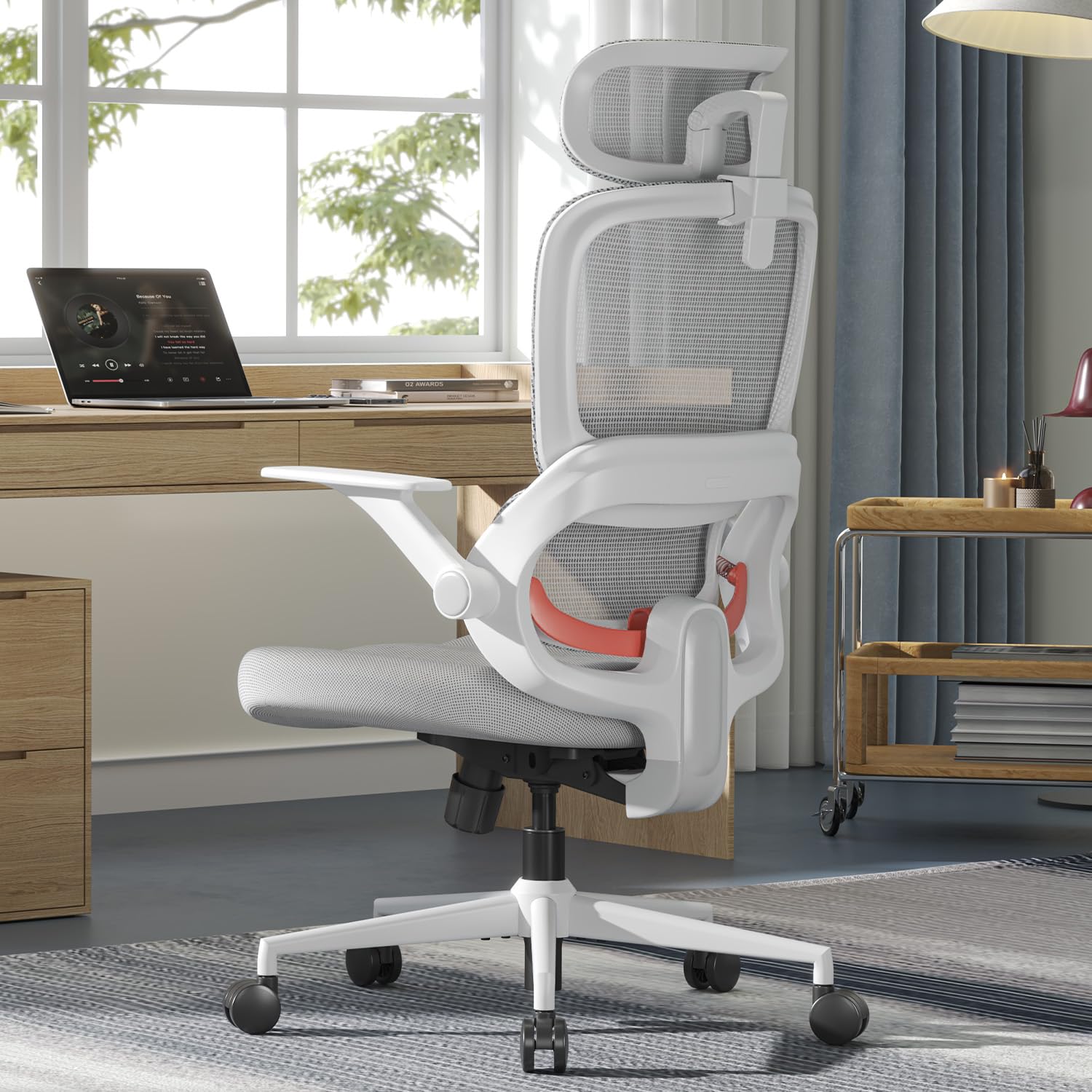
Choose the Hbada if its stated height range and 140° maximum recline match your needs and the specific lumbar-wing design appeals to you.
The SIHOO may be a better fit if you want a lumbar system with independently moving support and more armrest adjustment directions.
- The SIHOO B300 PRO describes a spring-assisted four-way lumbar system, an independently height-adjustable backrest, adjustable seat depth, a weight-sensing recline, and 6D armrests.
- The Hbada E3 Pro combines a three-zone adjustable lumbar assembly, a multi-axis headrest, and armrests with dual 360° rotation and folding.
Home Office Desk Chairs alternative
17,000+ ratings
Read Amazon ReviewsSIHOO B100 PRO with Footrest
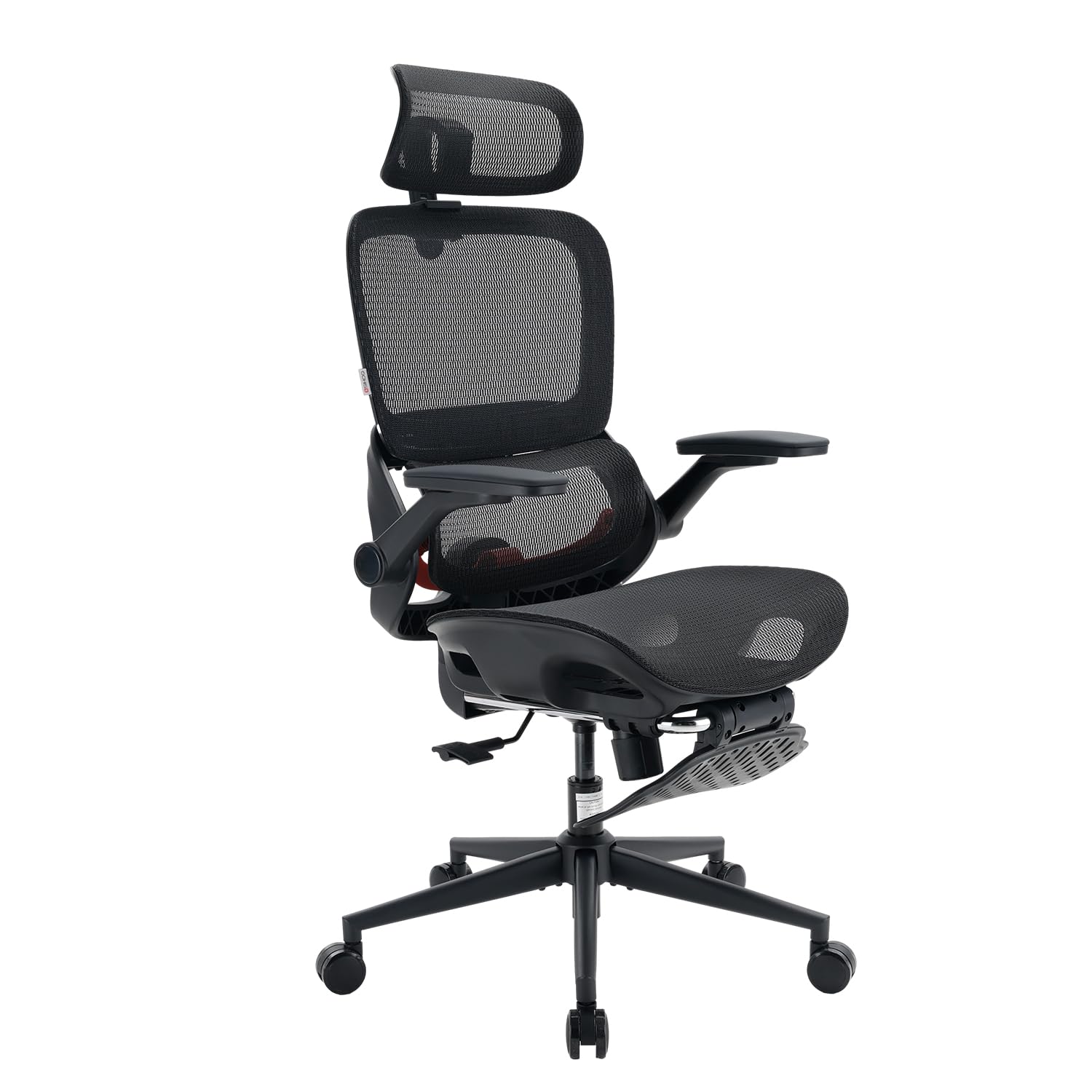
The Hbada is the stronger match for buyers prioritizing its adjustable headrest, lumbar wings, and higher stated recline limit.
Consider the SIHOO if a retractable footrest for stretching during breaks is more useful than the Hbada's particular support adjustments.
- The SIHOO B100 PRO includes a retractable footrest, three recline angles up to 135°, adaptive lumbar support, 4D armrests, and a 300-pound maximum weight recommendation.
- The Hbada E3 Pro is described with a 300-pound maximum weight recommendation and recline up to 140°, with no footrest mentioned in its product details.
Is Hbada E3 Pro Worth It?
The Hbada E3 Pro is worth considering if you want a highly adjustable mesh office chair, especially for lumbar positioning, headrest placement, and posture changes during the workday.
Its broad adjustment set makes it a more tailored option than a basic desk chair, provided you are comfortable spending time dialing it in.
Check the stated height and weight limits, desk fit, and seat dimensions before buying.
If those suit you and the adjustable support features align with your routine, the E3 Pro presents a compelling ergonomic feature set; if simplicity is your priority, its many controls may be more than you need.
Your review at a glance
1,000+ ratings
Read Amazon ReviewsHbada E3 Pro
A mesh office chair for desk workers who want adjustable lumbar, headrest, arm support, and recline for different seated postures.
- Three-zone lumbar support uses pivoting side wings with a stated 40°–80° movement range and 60 mm of vertical adjustment.
- The headrest adjusts by 70 mm in depth and 40 mm in height, with 70° of rotation.
- The chair reclines up to 140°, with suggested positions at 105°, 115°, 130°, and 140°; tilt tension is described as responding to body weight.
- The mesh seat and back are described as high-elasticity CloudMesh, with airflow as a design goal.